
Douglas Court Records After Arrest
Court records after a jail arrest in Douglas County start with the custody event, but they do not end there. Sheriff Jay Armbrister's Douglas County Kansas Sheriff's Office handles the jail side through the Douglas County Correctional Facility. Booking data may appear in DGSO reports first. Officers record basic personal history, complete pictures and prints, perform a pat-down before booking entry, and route medical screening at intake. Those steps explain why a person may show in custody before a formal case is easy to find in court records.
The court record is built from a different decision point. The Douglas County District Attorney, led by District Attorney Dakota Loomis in the current county materials, decides what charges to file in the Seventh Judicial District setting. Jail report charges are arrest or booking data. The filed case may later show amended, reduced, added, dismissed, or declined charges. For custody details, the Douglas County jail inmate records page fits better. For booking photos, use the Douglas County jail mugshots page.
The arrest-to-court flow is best read as: Arrest or warrant service -> booking at the correctional facility -> first appearance -> prosecutor charging decision -> CaseSearch or clerk record request. That sequence matters because a name can appear in the jail roster before the court file is indexed, and a court file can remain after the person is released from custody.
Douglas Arrest First Appearance
First appearance is the first court event after many Douglas County jail arrests. It is not a trial. It is the early hearing where the court addresses custody status, probable cause or warrant issues, bond, next hearing dates, and basic charge information. DGSO inmate services research states that District Court first appearances are held Monday through Friday at 3:00 p.m. and include new charges, probable cause warrants, and bench warrants scheduled in Pro-Tem court.
Municipal cases can follow a different schedule. The researched Douglas County materials list municipal first appearances on Monday at 8:45 a.m., Tuesday at 1:00 p.m., Wednesday at 8:45 a.m., Thursday at 8:45 a.m., and Friday at 1:00 p.m. Members of the public may attend at the correctional facility or by video conference at the specific court location when that option applies. These hearing details help explain why a court record after an arrest may not have a final charge status on the same day as booking.
Douglas Court CaseSearch Path
For public district court records after a Douglas County arrest, the main online path is Kansas CaseSearch. The Douglas County court records page says users should register for a Kansas District Court Public Access Portal account to search cases online. The Kansas Judicial Branch also says public district court records can be searched through CaseSearch, and public access is available at each courthouse on a reserved public computer.
The CaseSearch screen is useful after the District Attorney has filed a case or a clerk record is available for public view. It is less useful for a person who was just booked and has no filed case yet. If CaseSearch does not show the case, the next path is the Douglas County Court Records Request form for older records, sealed or unavailable files, or records that need clerk review.
The Kansas CaseSearch portal is the official statewide search point for many district court files:
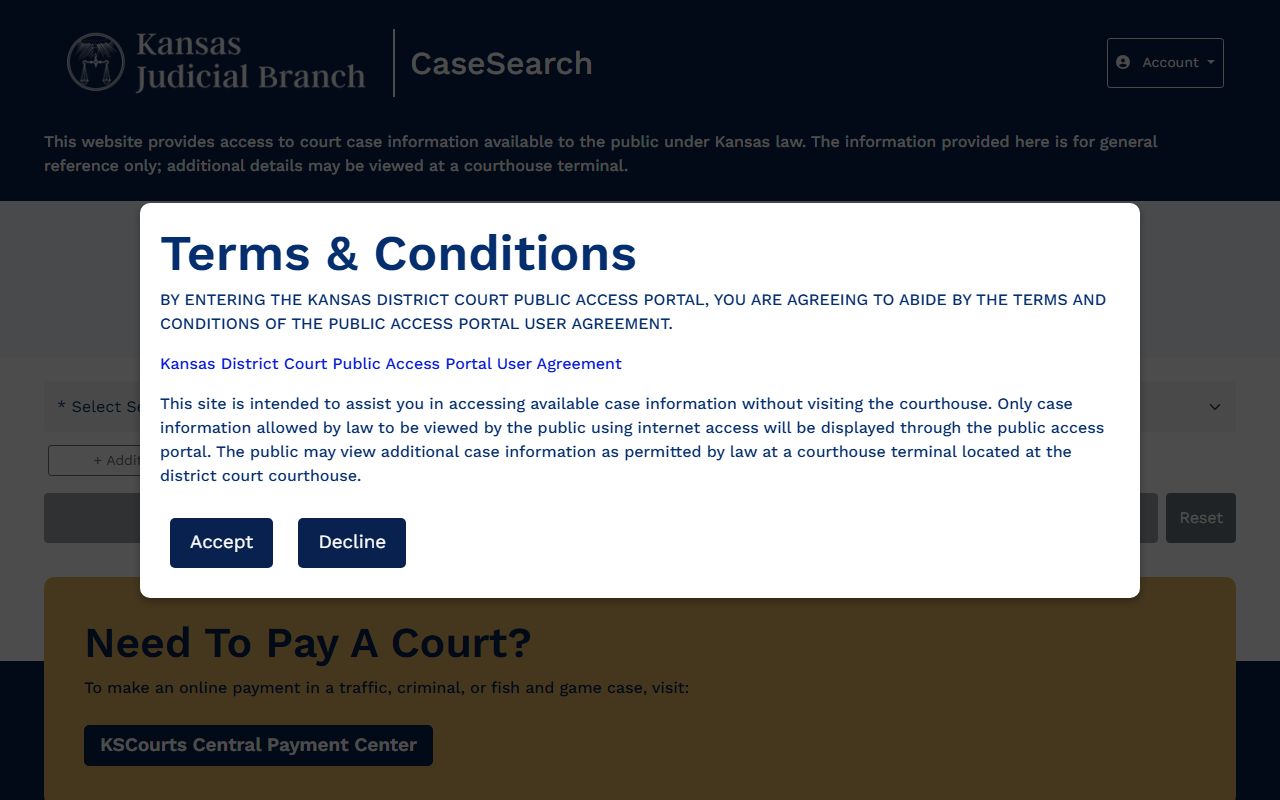
Use the portal for the filed court case, not for the jail booking record. The jail record and the court case may share a person and charge event, but they are maintained by different offices.
| Field Label | Type | Required | Notes |
|---|---|---|---|
| Case number | Text | Optional | Best when the exact case number is known from a notice, docket, attorney, or clerk record. |
| Party name | Text | Optional | Use the defendant's name for most criminal case searches after arrest. |
| Business name | Text | Optional | For entity parties rather than an individual defendant. |
| Citation | Text | Optional | Useful for traffic or municipal-linked matters when a citation number is known. |
| Role criteria | Role-dependent | Optional | The portal indicates that some criteria depend on the user's access role. |
The Douglas County Court Records Request form is the fallback when CaseSearch does not provide the record or a clerk must review access:
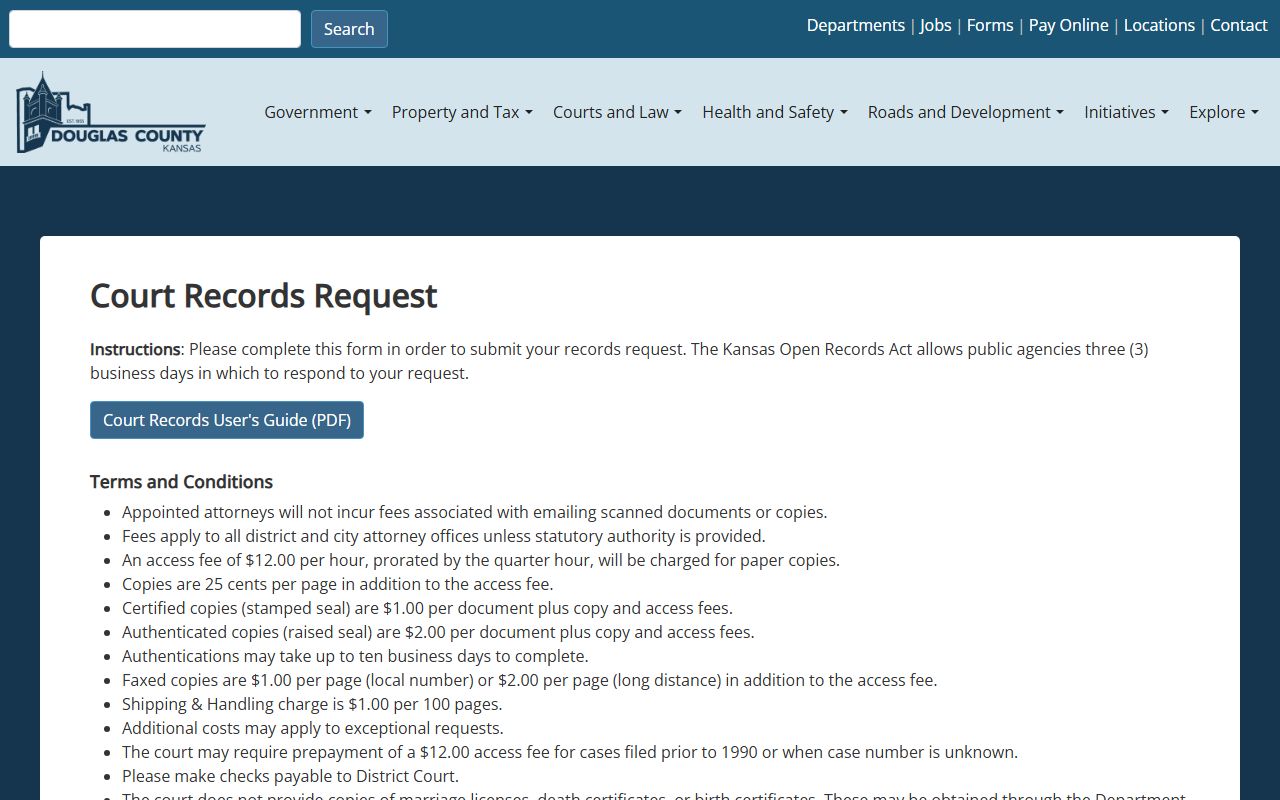
Use the clerk request path for older files, unavailable public portal records, and files that may require review before release.
Douglas Arrest Charging Records
Charging records are the formal bridge between a jail arrest and a court case. The first jail entry may list an arresting or holding agency and a booking charge. The court case turns on what the prosecutor files. In Douglas County, the District Attorney handles criminal charges after arrest, and those filings determine the formal case record used by the court.
The names of charging documents matter because they show how the case began. A complaint is commonly used to start a criminal case. An information is filed by the prosecutor and is often used in felony prosecution after review. An indictment is a grand jury charging document. The research did not locate a Douglas County rule that changes these plain Kansas criminal-case meanings, so the table uses the standard court-record distinctions without adding unsupported local rules.
| Document | Who Files It | What It Does | Why It Matters |
|---|---|---|---|
| Complaint | Officer or prosecutor | Starts a criminal case with alleged facts and charges. | Often appears near the start of court records after arrest. |
| Information | Prosecutor | Sets out prosecutor-filed charges, often after review. | May differ from jail booking charges if charges are changed. |
| Indictment | Grand jury | Charges a person after grand jury action. | Less common, but it is still a formal court charging record. |
Douglas Court Charge Status
Charge status is one reason court records after an arrest are more useful than a booking-only search. A booking charge is an early label. A court charge can move through several stages as the District Attorney reviews evidence, the defense responds, and the judge rules on motions or pleas. Public records may show several charges in one case, and each charge can have its own status.
| Status | Meaning in Court Records | Reader Caution |
|---|---|---|
| Pending | The charge has been filed and has not reached a final disposition. | Do not treat it as a conviction. |
| Amended | The charge text, level, or count has changed after filing. | Compare the newest docket entry with older arrest data. |
| Reduced | The filed charge has been lowered to a lesser charge. | The original booking label may still appear in older jail records. |
| Dismissed | The charge ended without a conviction on that count. | Other counts in the same case may still be active. |
| Declined | The prosecutor chose not to file that charge. | A declined charge may never appear as a public court case count. |
Douglas Arrest Bond Records
Bond is tied to the arrest-to-court path because release terms may be set or reviewed at first appearance. DGSO publishes a separate Bond Amounts WARP report for people with outstanding bonds. That report has a search box, Search and Clear buttons, visible stat cards, bond amount badges, and bond type classes that support cash or surety, no-bond, and own-recognizance terminology.
DGSO states that cash bonds can be paid through GovPayNet by major credit, debit, or prepaid debit card. The researched bond page lists Pay Location Code PLC #7014, the payment amount from the Bond Amount Report, defendant name, defendant date of birth, and CHRI number as needed details. Holds and detainers can still prevent release, so Corrections should verify eligibility before payment.
| Bond Type | How It Works | Possible Limit |
|---|---|---|
| Cash or surety | Payment is made in cash/card form or through an approved bonding company. | Fees and release timing depend on the case and jail processing. |
| Own recognizance | The person is released on a promise to appear, often called OR or PR release. | Conditions may still apply. |
| No-bond hold | No payment option is available on that hold or case at that time. | Court action or agency clearance may be needed. |
| Detainer | Another agency has a hold or interest in custody. | Release on the local case may not end custody. |
Douglas Arrest Warrant Checks
No official public Douglas County active warrant search page was located in the researched sources. That does not mean warrants are absent. It means the safest official path is a phone or clerk/court check rather than an unofficial warrant index. DGSO lists Warrants Inquiries at (785) 832-5368 and a warrants officer contact, Deputy Chris Chavez, at (785) 865-6212.
Warrant arrests may later appear in Booking Recap, Bond Amounts, or the in-custody report after the person is booked. Court records may show bench warrant activity when the underlying case is public. Probable cause warrants and bench warrants are also part of the first-appearance schedule noted in DGSO inmate services material. Municipal warrant questions may require Lawrence municipal court resources when the underlying case is municipal.
Note: For pre-arrest warrant questions, use the official DGSO warrant phone fallback instead of unofficial active-warrant sites.
Charges Versus Convictions
An arrest and a charge are not the same as a conviction. Douglas County court records after arrest can show a filed charge while the case is still pending. A conviction requires a plea, verdict, or other final finding accepted by the court. This distinction is central when reading CaseSearch results, bond records, and jail roster entries together.
| Point | Charge | Conviction |
|---|---|---|
| Stage | An accusation filed in court after arrest review. | A final finding by plea or verdict. |
| Proof | Based on probable cause and prosecutor filing standards. | Based on proof beyond a reasonable doubt or a valid plea. |
| Record use | Shows what was alleged and how the case is moving. | Shows the final criminal-history outcome for that count. |
| Status risk | May be amended, reduced, dismissed, or declined. | May later be subject to appeal, relief, or expungement rules. |
Douglas Arrest Access Limits
Kansas public access starts with the Kansas Open Records Act. K.S.A. 45-215 states the open-records policy, and K.S.A. 45-216 makes public records generally open for inspection subject to rules and exemptions. K.S.A. 45-221 lists exemptions, including criminal investigation records, so not every police or jail-related item is released in the same way.
Expungement is the Kansas record-clearing route for many arrests, convictions, and diversions. K.S.A. 21-6614 controls many expungement issues. It does not mean each record vanishes from every internal government system. It can restrict public access when the person is eligible and the court grants relief.
| Point | Sealed | Expunged |
|---|---|---|
| Public visibility | Hidden or limited from ordinary public access. | Restricted under the expungement order and statute. |
| How it happens | By court rule, statute, or order for protected records. | By petition and court order when Kansas law allows it. |
| Law enforcement access | May remain available to limited agencies. | May remain available for specific statutory purposes. |
| Douglas County path | Ask the clerk about access to a specific sealed case. | Use court process under K.S.A. 21-6614, not a web removal request. |
Douglas Criminal History Checks
CaseSearch is a court-record tool, not a full criminal-history background check. For a statewide Kansas criminal history search, the research identifies the Kansas Bureau of Investigation criminal history portal. The Kansas.gov instructions list a $30 purchase price for a name-based record check and state that searches are available from 4:00 a.m. to midnight Central Time.
Kansas criminal history dissemination is governed by K.S.A. 22-4716. That statewide search can answer a different question than Douglas County court records after arrest. Use court records for filings, hearings, and dispositions in a known case. Use the KBI portal when the goal is a Kansas criminal-history check, and do not treat a jail booking as a final record of guilt.
Important: Public case and jail data may be incomplete or out of date, and it is not for FCRA-covered screening.